From Property Management System Data to Reconciled Hotel Accounts
How hotel finance teams connect property management, payment, settlement and ledger data to reconcile revenue, guest balances and receipts.

Xian Hui
4 August 2026
Quick answer
How can hotel and serviced-apartment reconciliation be automated?
A connected workflow imports transactions from the property management system, payment platforms, settlement reports and bank records. It applies finance-approved mappings, reconciles revenue, deposits, guest and city ledgers, card settlements and agent receipts, then sends missing references, unmatched amounts and other exceptions to the responsible team for review.
From Property Management System Data to Reconciled Hotel Accounts
Hotel revenue passes through several records before it reaches the accounts. A reservation can produce a deposit, daily charges, refunds, card receipts, agent commissions and a bank settlement on different dates.
The property management system records the stay, but payment platforms, online travel agents, banks and the general ledger hold other parts of the transaction. Finance must connect them before it can rely on revenue, receivables, deposits and clearing balances.
Why does hotel reconciliation matter?
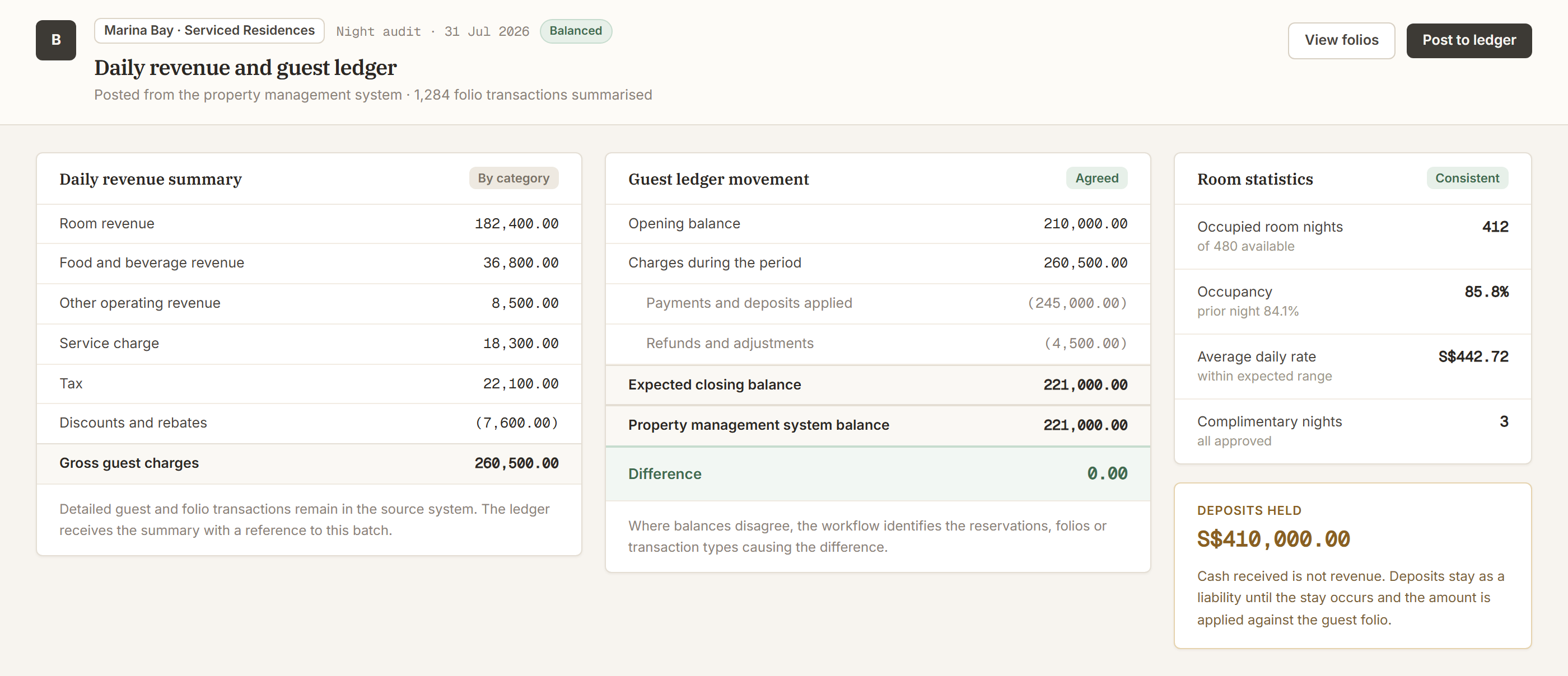
Daily reconciliation establishes whether guest activity has reached the accounts completely and under the approved treatment. It also gives finance an early view of missing postings, duplicate charges, unsettled receipts and unexplained differences.
The work continues at month end. Finance must reconcile the guest ledger, city ledger, card clearing, agent receivables, deposits and cash before closing the period. A difference may reflect timing, an incomplete interface or an error, and the team needs the source record to tell them apart.
Hotels with several properties repeat the same checks for each location. Consistent mappings and reconciliation formats matter, but each transaction must remain traceable to its property, reservation, folio and settlement.
What makes the work slow and error-prone?
The systems describe the same activity in different ways. The property management system may record revenue by stay date, the payment platform by transaction date and the bank by settlement date. An acquirer or online travel agent may also combine transactions and remit a net amount after fees, refunds or adjustments.
Finance therefore has to align:
- reservation, folio, payment and settlement references
- operational, transaction and bank dates
- gross charges, deductions and net receipts
- property, charge, payment and customer codes
Spreadsheets can perform individual comparisons, but staff must first download reports, reshape columns, maintain mappings and determine which version is current. The repeated handling creates more opportunities to omit a file, reuse an outdated mapping or overwrite an explanation.
Why does the property management system not solve the problem?
The property management system is the main operational record for reservations and guest charges. It does not contain every agent statement, acquirer deduction, bank receipt or general-ledger balance needed for a complete hotel reconciliation.
The accounting system has the opposite limitation. It holds the posted financial effect but usually lacks the detailed reservation and settlement records required to explain a difference. Uploading a daily revenue summary transfers totals without proving that the underlying populations agree.
A direct connector can remove the download-and-upload step, but it still needs controlled mappings, validation and reconciliation. Where the target ledger is Xero, the connector must also work within its published API rate limits and accounting API thresholds.
How does the connected workflow work?
The workflow imports detailed transactions from the property management system and related sources. It retains the original references, standardises codes and applies mappings approved by finance.
| Source record | Mechanical treatment | Reconciliation target |
|---|---|---|
| Room and other charges | Map charge codes to approved accounts and tax codes | Daily revenue and guest ledger |
| Advance deposits | Separate receipts from earned revenue | Deposit liability and guest folio |
| Corporate folios | Match transfers, invoices, credit notes and receipts | City ledger and trade receivables |
| Card payments | Match receipts, refunds, chargebacks and fees | Acquirer settlement and bank |
| Agent bookings | Match the reservation, commission and remittance | Agent statement and bank |
| Front-office cash | Compare system receipts, cashier records and deposits | Cash count and bank |
Unrecognised codes, missing references and unmatched amounts do not pass into a general suspense account automatically. The workflow places them in an exception queue with the source, property, date, amount and reason for review.
The validated transactions then produce the daily revenue summary and proposed accounting batch. The batch remains linked to the detailed records so that finance can move from a ledger total back to the relevant reservations and folios.
How are settlements and clearing balances reconciled?
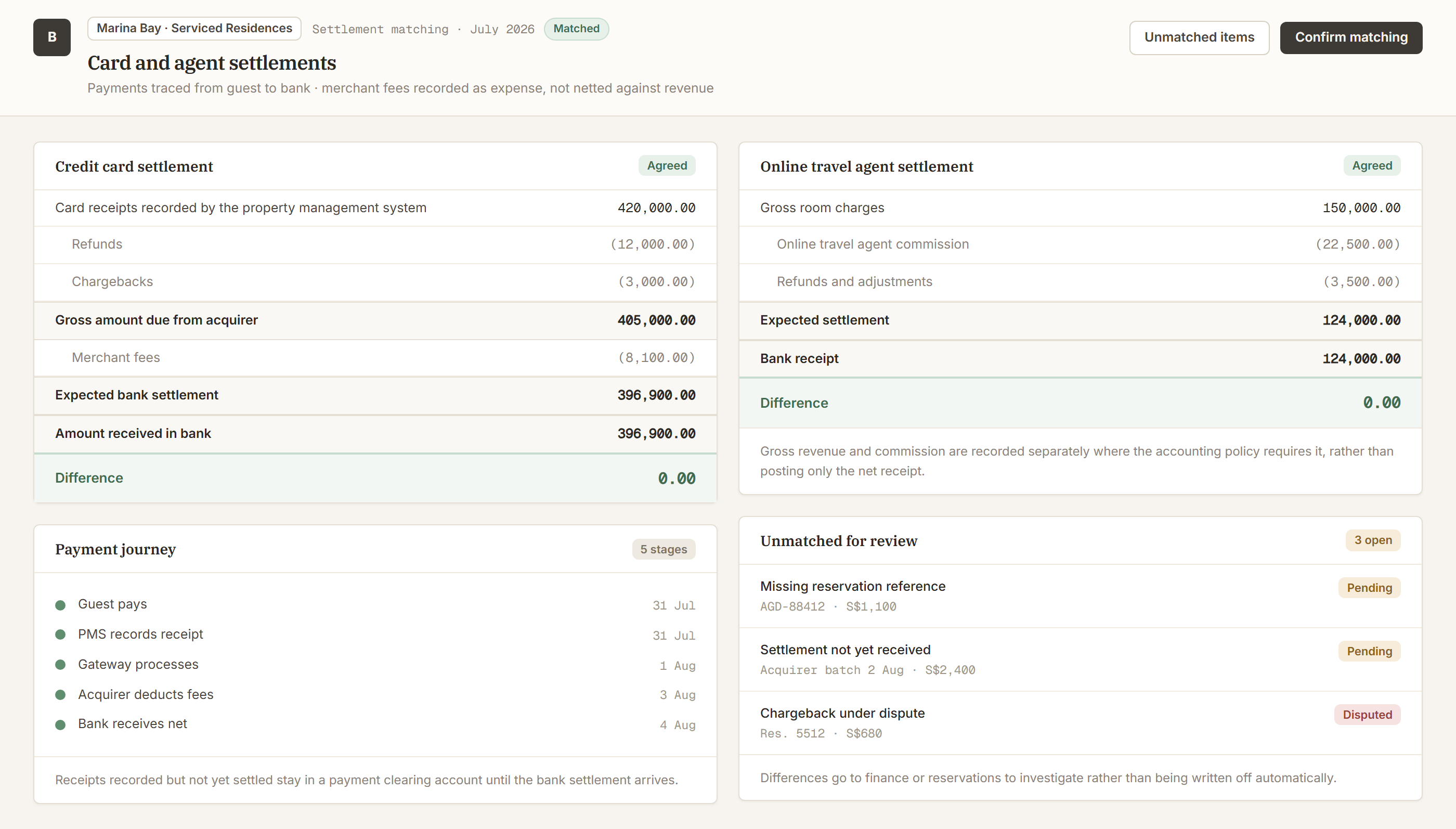
Card and agent receipts pass through several stages. The workflow starts with the payment recorded against the guest, matches it to the processor or agent statement, separates deductions and compares the expected net settlement with the bank receipt.
A published example in this process starts with S$420,000 of card receipts. After S$12,000 of refunds, S$3,000 of chargebacks and S$8,100 of merchant fees, the expected bank settlement is S$396,900. The value of the reconciliation lies in preserving that bridge rather than matching only the original receipt to the net bank amount.
The same structure applies to online travel agents. Gross room charges, commission, refunds and adjustments remain separate, while unresolved differences stay assigned for investigation. This is the more detailed hospitality application of merchant settlement reconciliation.
How does finance retain control?
Finance approves the charge mappings, accounting treatment and cut-off rules before the workflow uses them. Operations remains responsible for the accuracy of reservations, folios, cashier records and other property data.
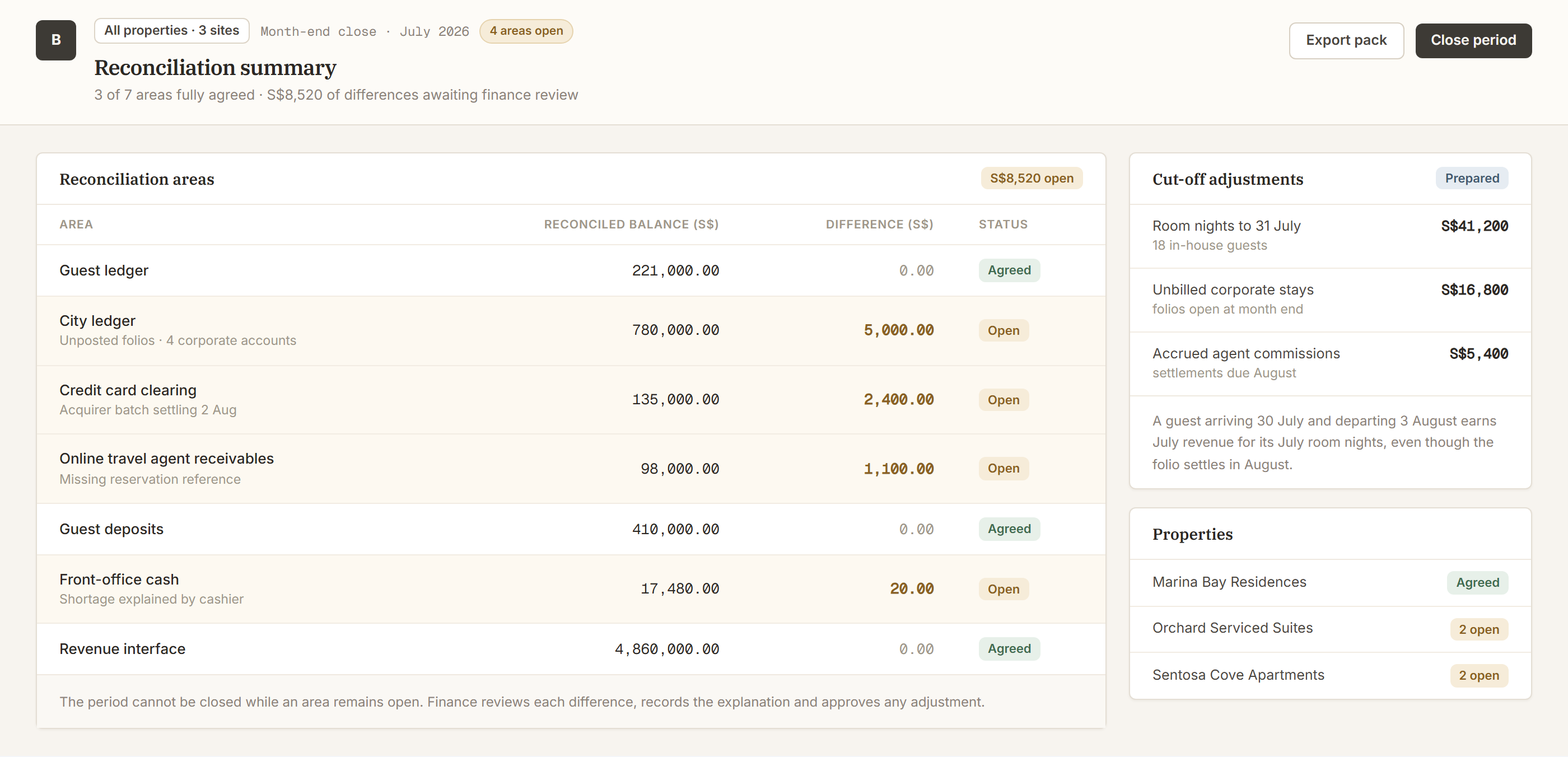
At period end, the workflow identifies stays, refunds, commissions and settlements that cross the reporting date. It prepares the supporting calculation, but finance decides whether to record the adjustment and whether the remaining differences permit the period to close.
The month-end board shows the reconciled balance and outstanding difference for each area and property. Each exception retains its owner, evidence, status and resolution. The same control structure can feed a broader month-end closing workflow and a controlled high-volume accounting pipeline.
Backbone helps hotel and serviced-apartment finance teams connect operating data, settlements and accounting entries in one controlled workflow — while keeping accounting judgement and period-end approval with finance.
Frequently asked questions
This information has been prepared for general informational purposes only and is not intended to be relied upon as accounting, tax, or other professional advice.
Related articles
case-studies
From Receipt Submission to Petty Cash Reimbursement
How finance teams can connect expense claims, receipt checks, approvals, payments, accounting entries and petty cash reconciliation in one controlled workflow.
case-studies
From Headcount Plan to Payroll Forecast
How finance and people teams can maintain an employee-level payroll forecast as hiring, compensation and employer-cost assumptions change.
case-studies
From Historical Cash Movements to a Rolling Cash Flow Forecast
How finance teams connect bank balances, receivables, payables and planned commitments to maintain a rolling cash flow forecast.