From Historical Cash Movements to a Rolling Cash Flow Forecast
How finance teams connect bank balances, receivables, payables and planned commitments to maintain a rolling cash flow forecast.

Xian Hui
11 August 2026
Quick answer
How can cash flow forecasting be automated?
A connected rolling cash flow forecast starts with current bank balances, refreshes receivables and payables, and adds payroll, recurring commitments, financing and planned expenditure by expected payment date. Finance maintains customer-specific timing, overrides material items, runs scenarios and reviews forecast-to-actual differences while the model replaces completed periods with actual results.
From Historical Cash Movements to a Rolling Cash Flow Forecast
Cash pressure arises from timing. Customer receipts may follow payroll, tax, supplier payments or capital expenditure even when the business remains profitable.
A current forecast gives management time to adjust payment timing, collections or funding before cash falls below the required level. That warning depends on credible dates and assumptions rather than a monthly total assembled from stale exports.
The recurring burden is keeping the model current. Finance must replace estimates with actual results, refresh outstanding items and extend the forecast without losing its assumptions or review history.
Why does a reliable cash forecast matter?
A cash forecast shows when expected receipts and payments affect available cash. It should distinguish cash held from cash available for operations and show headroom against the minimum set by management.
Timing makes the forecast useful. A receipt expected after a payment run cannot fund that run, while an annual commitment creates a cash movement that its monthly accounting treatment does not show.
A credible forecast also gives meaning to variance. When actual cash differs from a well-supported forecast, finance can investigate whether collection behaviour, payment timing or an operating assumption changed.
Why is the forecast difficult to maintain?
The model draws from bank accounts, receivables, payables, payroll, recurring commitments, financing schedules and operational plans. Some items already exist in the ledger; future billing, planned expenditure and funding decisions may not.
Source systems also hold different dates. An invoice due date may not reflect the expected collection date, and a supplier due date may differ from the next scheduled payment run.
Finance commonly repeats four types of work:
- exporting and reconciling balances and open items
- updating expected collection and payment dates
- entering commitments and assumptions held outside the ledger
- replacing completed periods and extending the forecast horizon
Each manual transfer creates another opportunity to retain a settled item, omit a new commitment or overwrite an adjustment. The forecast may therefore be out of date when management receives it.
Why does the accounting system not solve the problem?
The accounting system remains an important source, but it records only part of the forecast. The Xero Accounting API, for example, exposes accounting data and reports, while its invoice endpoint provides invoice records. Neither source determines when a disputed receivable will clear or when management will approve planned expenditure.
A spreadsheet can add that judgement, but it leaves finance to repeat the extraction, mapping and roll-forward. It also makes overrides hard to distinguish from source data and can separate scenarios from the assumptions that created them.
The useful division is clear: source systems supply current records, the connected model applies controlled rules, and finance owns assumptions and exceptions.
What information should the connected model combine?
The model starts with the latest included bank balances. It then places expected movements into the period in which cash should enter or leave.
| Forecast component | Source or basis | Finance review |
|---|---|---|
| Opening cash | Bank or accounting records | Exclude restricted or unavailable balances |
| Customer collections | Receivables and future billing | Adjust material expected dates |
| Supplier payments | Payables and approved commitments | Apply payment-run timing |
| Payroll | Payroll and headcount information | Confirm bonuses and planned changes |
| Recurring costs | Contracts and payment schedules | Update amount, frequency or end date |
| Tax and financing | Approved schedules and estimates | Confirm timing and inclusion |
| Capital expenditure | Approved projects and milestones | Record deposits and staged payments |
Where the ledger supports direct extraction, an API can retrieve records without repeated download and upload work. The same principle applies when high-volume transactions move into Xero: systems should exchange structured data through the most dependable available connection.
The model keeps source values separate from manual adjustments. A reviewer can then see the retrieved date, the applied rule, any override and who approved it.
How does the forecast roll forward?
The workflow groups each expected receipt and payment by date, calculates the closing balance and carries that balance into the next period. It compares the result with management’s minimum cash threshold and flags the first projected shortfall.
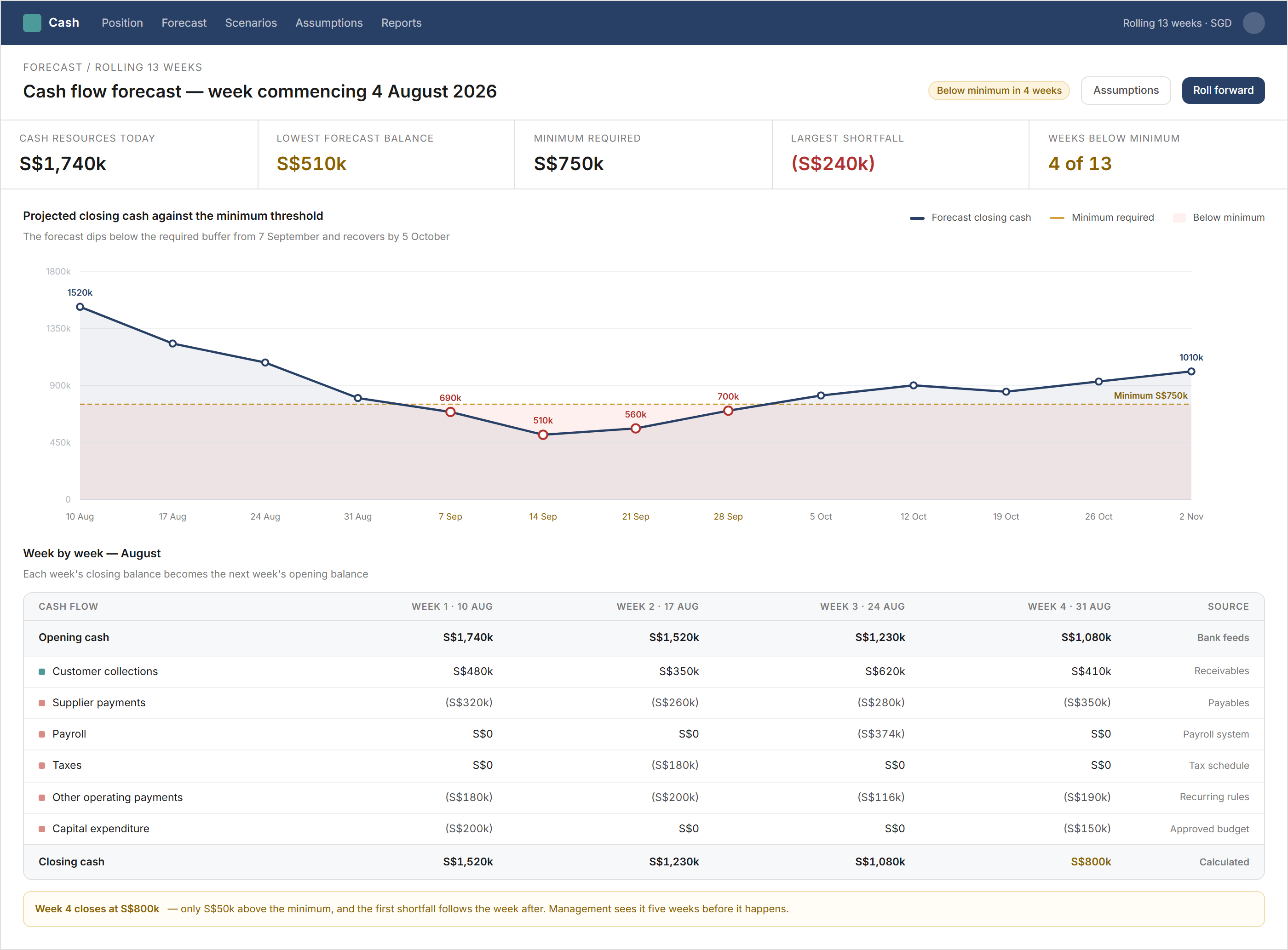
At the end of each period, the workflow:
- replaces forecast movements with actual results
- refreshes outstanding receivables, payables and commitments
- applies approved changes to assumptions
- adds a new period at the end of the horizon
This roll-forward connects naturally with the controlled month-end closing workflow, which confirms the actual figures used for comparison. Finance reviews exceptions rather than rebuilding the forecast.
How are scenarios and sensitivities kept useful?
Scenarios should change defined assumptions in the same model. A downside case may delay receipts, reduce future billing or move funding later; an upside case may improve collections or defer capital expenditure.
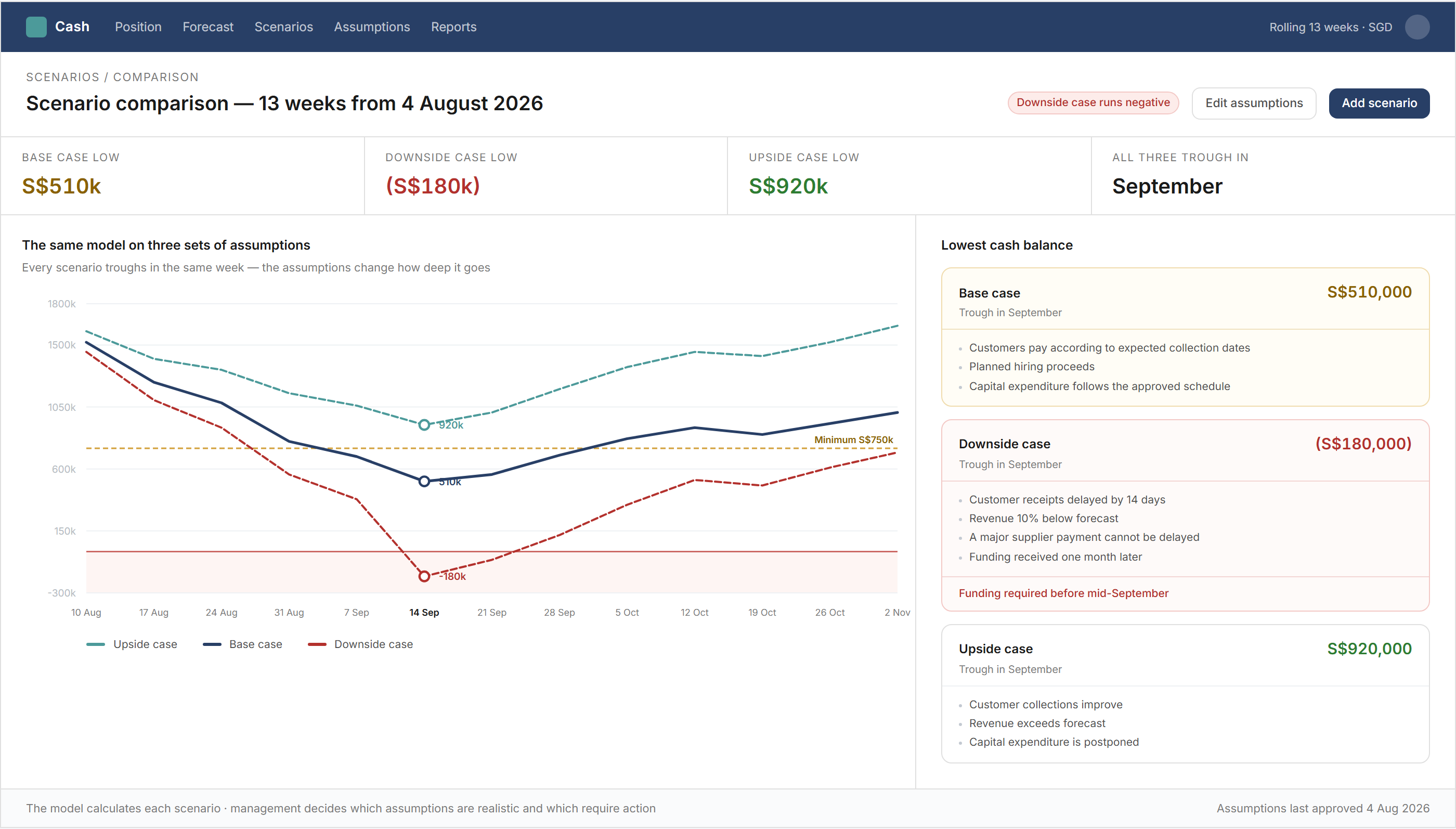
The comparison should show the lowest cash balance, when it occurs and which assumptions produce the movement. Management can then assess a funding need or operational response against a stated case rather than a detached spreadsheet copy.
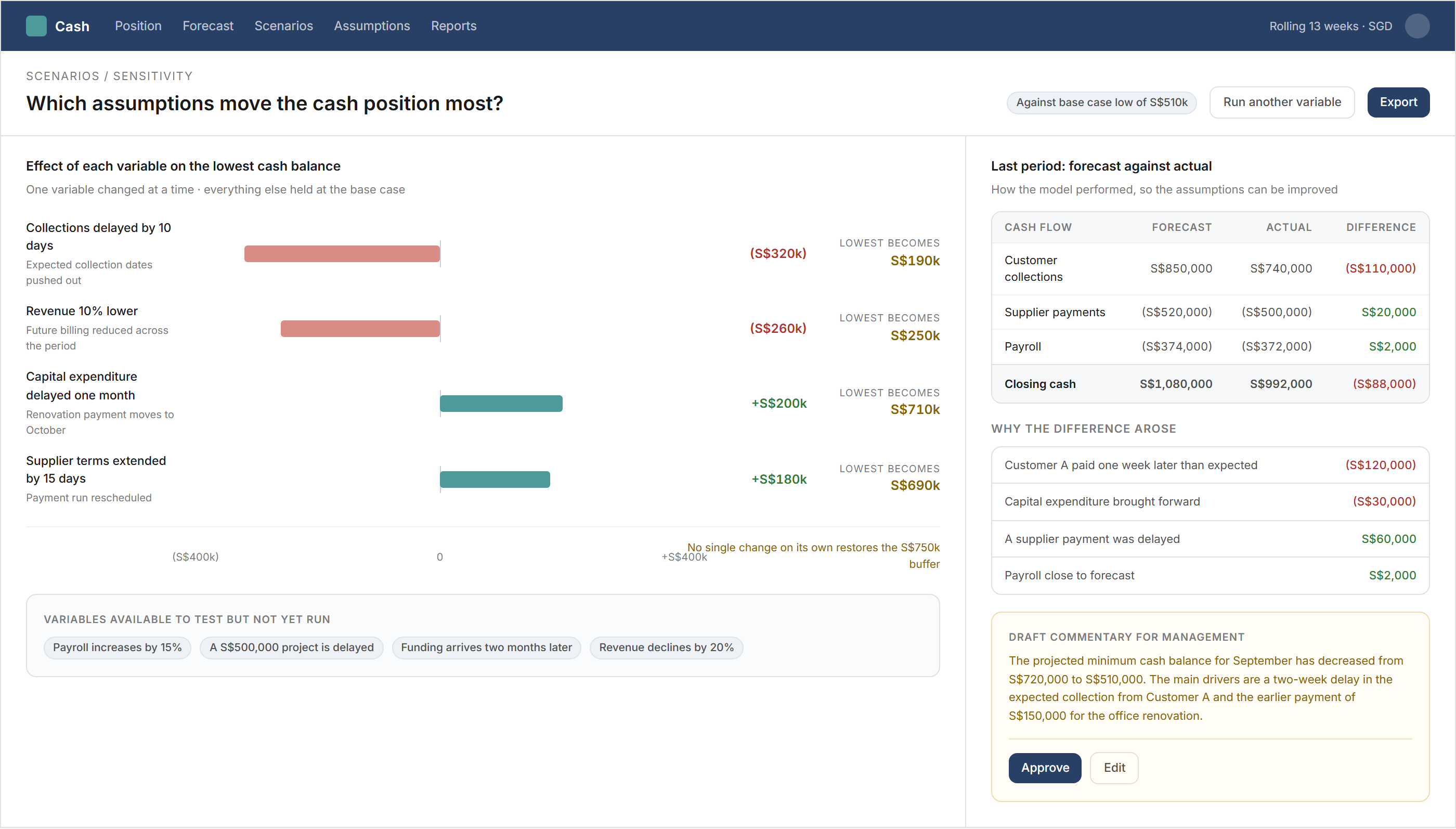
Sensitivity analysis changes one variable at a time. This identifies whether collection timing, revenue, supplier terms or planned expenditure has the greatest effect on minimum cash.
Where does finance remain in control?
Finance determines which balances are available, how expected dates should be calculated and when an individual item needs an override. It also approves recurring commitments, scenarios, minimum cash thresholds and management commentary.
The workflow should expose its calculation rather than conceal it. Reviewers need to trace each forecast movement to a source record, rule or approved assumption and compare the previous forecast with actual cash.
Automation removes repeated assembly, not professional judgement. Backbone helps finance teams connect current records, forward commitments and controlled assumptions in a rolling cash flow model — while keeping liquidity and funding decisions with finance and management.
Frequently asked questions
This information has been prepared for general informational purposes only and is not intended to be relied upon as accounting, tax, or other professional advice.
Related articles
case-studies
From Headcount Plan to Payroll Forecast
How finance and people teams can maintain an employee-level payroll forecast as hiring, compensation and employer-cost assumptions change.
case-studies
Pat: An AI Agent That Works Across Our Business
How an internal AI agent retrieves information, prepares routine work and coordinates approved actions across business systems while people retain authority.
case-studies
From Subsidiary Trial Balances to Consolidation Packages
How group finance can standardise subsidiary trial balances, reporting schedules, intercompany balances and adjustments before consolidation begins.