From Subsidiary Trial Balances to Consolidation Packages
How group finance can standardise subsidiary trial balances, reporting schedules, intercompany balances and adjustments before consolidation begins.

Xian Hui
5 August 2026
Quick answer
How can consolidation package preparation be automated?
A controlled workflow imports each subsidiary trial balance, applies approved group account mappings and populates the required reporting schedules. It validates the package, compares intercompany positions and applies approved exchange rates before submission. Local and group finance review exceptions, adjustments and proposed eliminations rather than assembling and checking separate spreadsheets.
From Subsidiary Trial Balances to Consolidation Packages
Group finance cannot review consolidated results until each subsidiary has provided complete and comparable information. When entities use different ledgers, charts of accounts, currencies and reporting files, much of the close becomes data preparation rather than consolidation.
A controlled consolidation package workflow moves that preparation to the subsidiaries. It standardises each submission, checks it against group requirements and brings unresolved matters to finance before the figures enter the consolidation.
Why does group reporting matter before consolidation begins?
The consolidation depends on the quality of the underlying entity packages. Group finance needs each subsidiary to report on the same basis, with supporting schedules, intercompany counterparties and consolidation adjustments clearly identified.
Without that discipline, the consolidation stage becomes the place where teams discover missing accounts, incomplete schedules and inconsistent interpretations. Review starts late because group finance must first establish which figures are usable.
The package also provides a controlled route from local records to group reporting. This complements the wider month-end closing workflow, where entity balances and reconciliations are completed before submission.
What makes consolidation packages slow and error-prone?
A subsidiary may extract its trial balance, copy balances into a group template, complete separate schedules and convert figures into the reporting currency. Staff then send the files to group finance, answer questions and issue revised versions.
Group finance repeats similar checks across every entity. The recurring workload includes:
- confirming that the correct trial balance and reporting period were submitted
- mapping new local accounts to the group chart of accounts
- checking supporting schedules against reported balances
- comparing intercompany positions between counterparties
- tracking explanations, adjustments, approvals and revised packages
Differences in account structures compound the work. A group mapping may place one entity’s “4000 Sales” and another entity’s “70001 Product Revenue” under the same reporting line, but finance must approve that treatment. The mapping depends on a well-governed group chart of accounts.
Why do ordinary spreadsheets not solve the problem?
Spreadsheets can combine trial balances and calculate reporting schedules. They do not, by themselves, control which source file is current, who approved a mapping or whether every subsidiary has resolved its exceptions.
A template also separates related work. Intercompany differences may sit in one file, adjustment journals in another and review comments in email. Group finance must reconstruct the status of each package before it can decide whether consolidation should proceed.
The weakness is not the spreadsheet calculation. It is the surrounding workflow: collecting files, managing versions, assigning follow-up and retaining evidence of review. Power Query or consolidation software may process the numbers, but they still need complete, approved and consistently structured inputs.
What should the workflow check before submission?
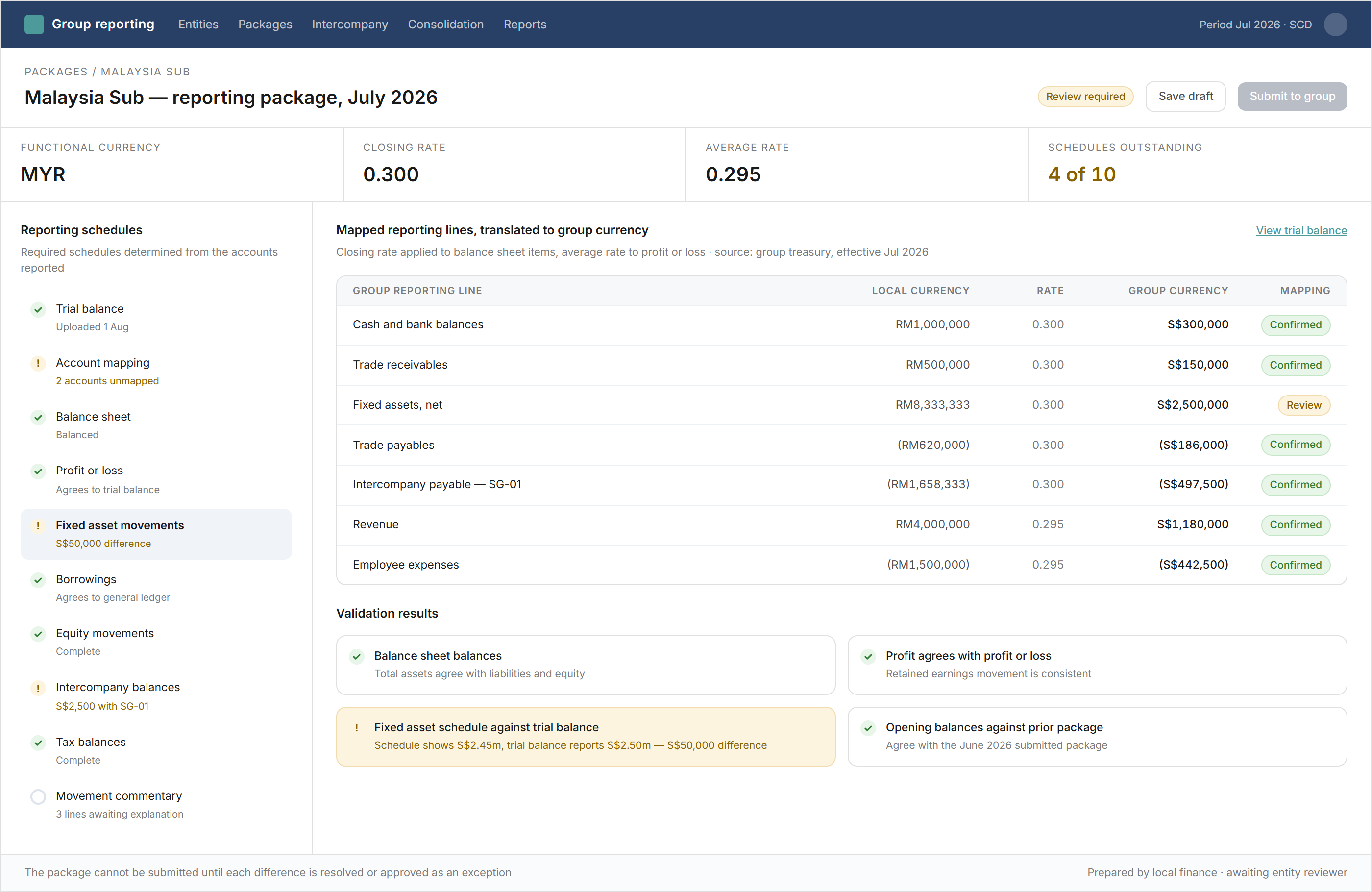
Each subsidiary uploads or connects its trial balance while retaining the original account codes, descriptions, currency and source. The workflow checks the period, control totals, opening balances, duplicate records and required reporting dimensions.
It then applies confirmed mappings and populates the required schedules. New accounts remain visible until finance approves their treatment; the system does not send them to a miscellaneous category merely to complete the package.
| Stage | System preparation | Finance responsibility |
|---|---|---|
| Trial balance import | Structures source balances and runs completeness checks | Local finance confirms the source and period |
| Account mapping | Applies approved mappings and flags new accounts | Finance approves additions and changes |
| Reporting schedules | Populates applicable schedules from available data | Local finance confirms the supporting detail |
| Currency translation | Applies approved rates consistently | Group finance approves rates and methodology |
| Submission | Locks the approved package and records later revisions | Entity and group reviewers approve release |
The workflow records entity reporting adjustments separately from local ledger balances and group consolidation adjustments. That separation preserves the origin, supporting document, preparer, reviewer and status of each amount.
How are intercompany and currency differences handled?
Each subsidiary identifies the counterparty against its intercompany balances. The workflow compares both sides by entity, counterparty, account, reference, currency and reporting period, then shows unmatched amounts to the relevant teams.
A Singapore entity may report a receivable of S$500,000 while its Malaysian counterparty reports a payable of S$497,500. The S$2,500 difference remains an exception until the entities investigate it. Finance decides whether the cause requires a local correction, a timing explanation or a consolidation adjustment.
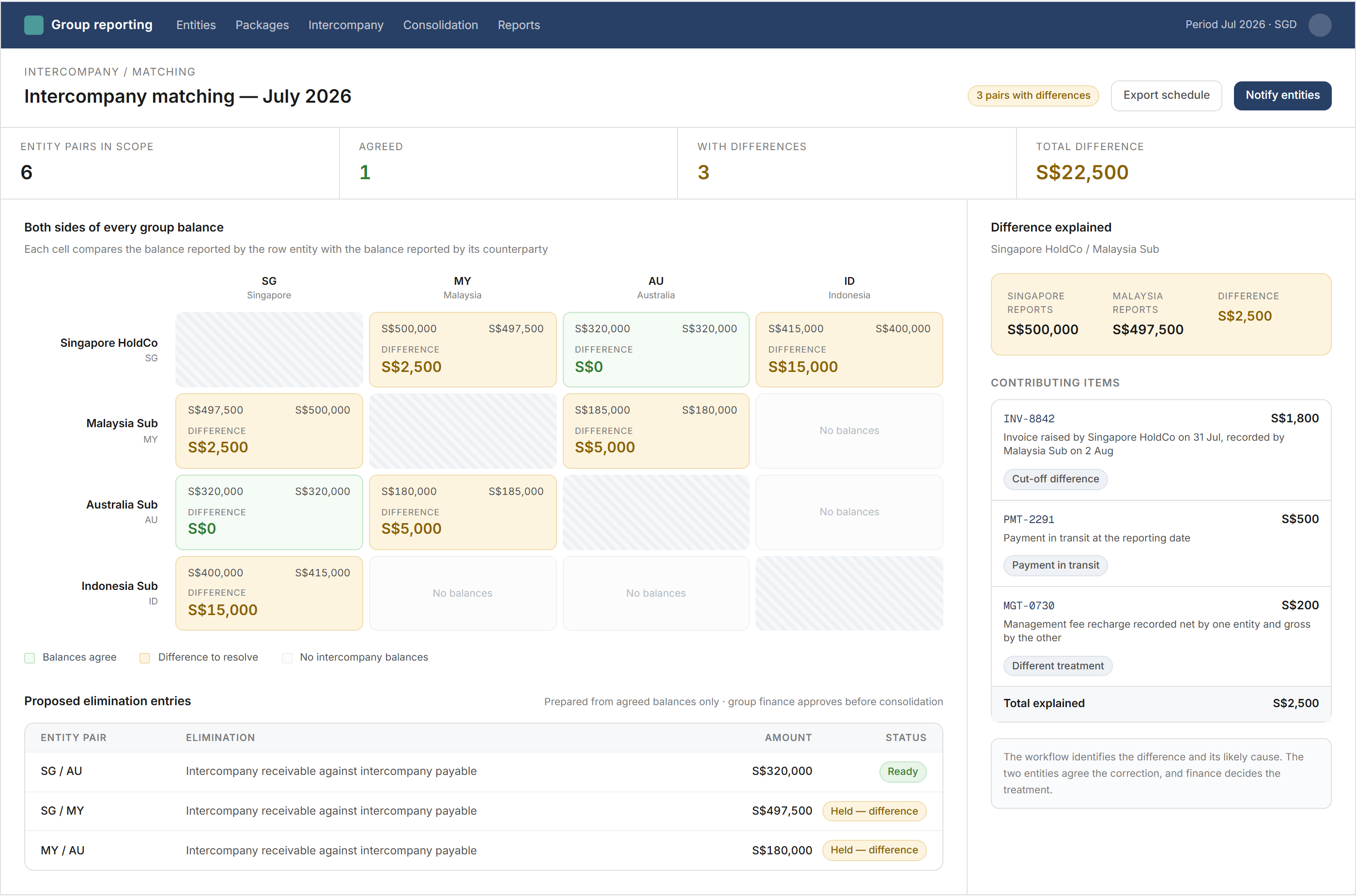
For entities with different functional currencies, the workflow stores the approved closing, average or historical rates and applies them to the relevant reporting lines. Group finance controls the methodology in accordance with its accounting policy and the requirements addressed by IAS 21, The Effects of Changes in Foreign Exchange Rates.
The system calculates translated values and prepares any required translation difference for review. It does not choose the accounting treatment or approve the rates.
How does group finance control the final package?
A group dashboard shows which entities have uploaded their trial balances, completed their schedules, obtained local approval and resolved material exceptions. Review comments stay attached to the relevant reporting line or schedule instead of moving through separate email threads.
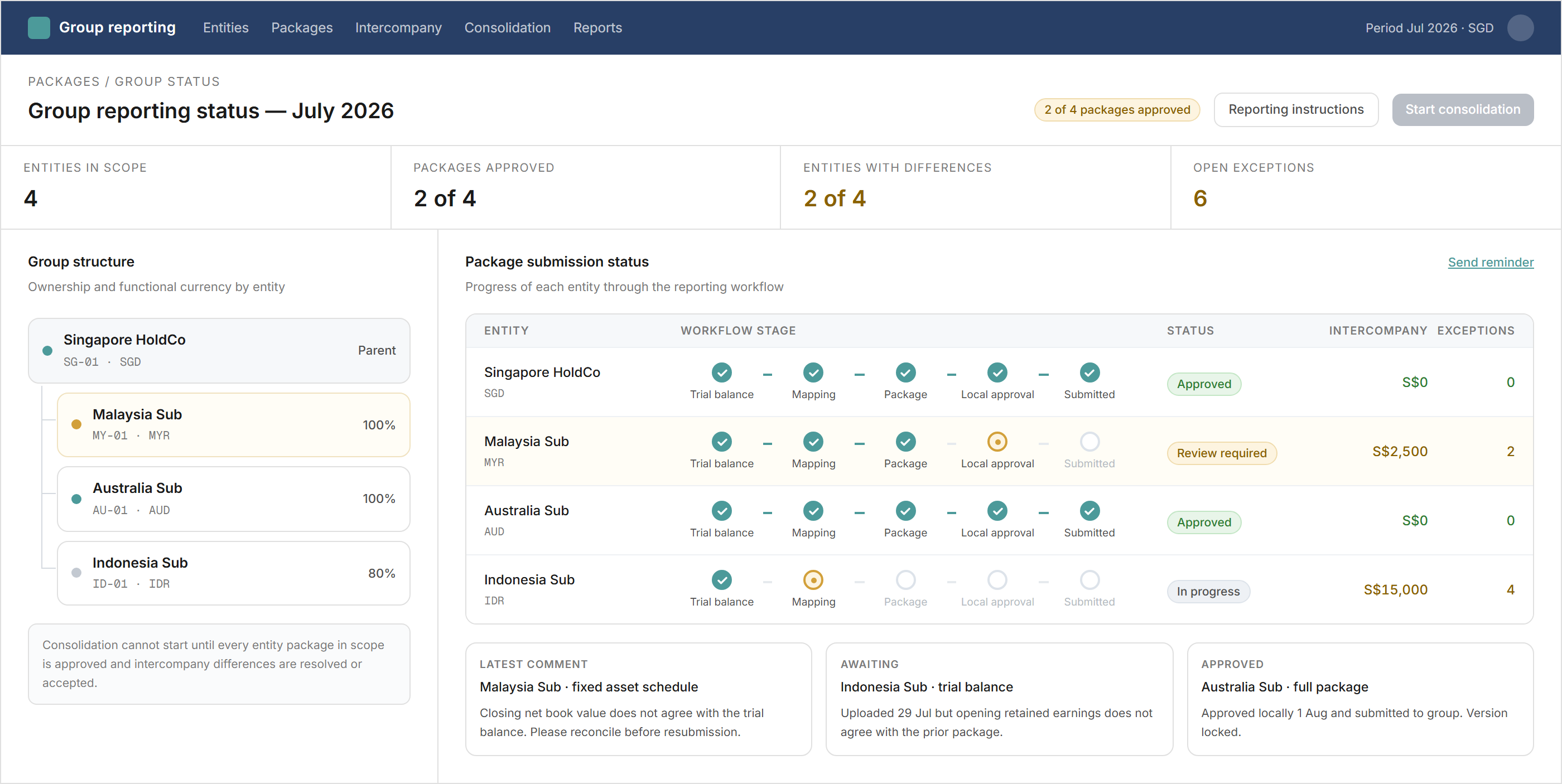
Once group finance accepts the package, the workflow locks that version. A later change creates a controlled resubmission while preserving the earlier trial balance, mappings, schedules, exchange rates, adjustments, comments and approvals.
The approved packages provide standardised inputs for the group process governed by IFRS 10, Consolidated Financial Statements. They can also feed a controlled process for turning client data into audit working papers, with the source and review history retained.
What does a connected consolidation workflow change?
The workflow does not replace consolidation or the judgements behind it. It brings source control, account mapping, schedule completion, intercompany matching and package validation into one sequence.
Group finance receives a traceable dataset rather than a collection of files that still require preparation. Its reviewers can concentrate on exceptions, group adjustments and final entries instead of rebuilding the status of each subsidiary submission.
Backbone helps finance teams connect subsidiary trial balances, reporting schedules, intercompany matching and review in one controlled workflow — while keeping accounting judgements and final consolidation with finance.
Frequently asked questions
This information has been prepared for general informational purposes only and is not intended to be relied upon as accounting, tax, or other professional advice.
Related articles
case-studies
From Headcount Plan to Payroll Forecast
How finance and people teams can maintain an employee-level payroll forecast as hiring, compensation and employer-cost assumptions change.
case-studies
From Historical Cash Movements to a Rolling Cash Flow Forecast
How finance teams connect bank balances, receivables, payables and planned commitments to maintain a rolling cash flow forecast.
case-studies
Pat: An AI Agent That Works Across Our Business
How an internal AI agent retrieves information, prepares routine work and coordinates approved actions across business systems while people retain authority.