From Client Data to Audit Working Papers
How an audit team converts client accounting data into mapped accounts, lead schedules, working papers and traceable samples through one controlled workflow.

Xian Hui
22 July 2026
Quick answer
How do you turn client data into audit working papers?
A controlled audit workflow validates the client's trial balance and general ledger, retains the source records and routes account mapping to the auditor. Once approved, the same data populates lead schedules and procedure-specific working papers. The workflow then applies the auditor's materiality and sampling decisions while recording every source, parameter, exception and review.
From Client Data to Audit Working Papers
Audit work depends on evidence that remains traceable from the financial statements to the client records and the procedures performed. Before testing begins, the team must turn the trial balance and general ledger into a reliable audit file.
That preparation is slow when client formats vary and each schedule sits in a separate workbook. A controlled workflow can perform the mechanical assembly while leaving mapping, materiality, procedures, sampling and conclusions with the auditor.
Why does audit file preparation take so long?
The client provides a trial balance and general ledger, often in formats specific to its accounting system. Account codes and descriptions also differ between clients, even where the underlying balances belong in the same audit section.
The team must first confirm that the files are complete and that the ledger agrees with the trial balance. It then maps the accounts, populates lead schedules, creates working papers and extracts the transaction populations required for testing.
The repeated tasks include:
- reconciling the trial balance and general ledger
- mapping client accounts to audit sections
- transferring balances into lead schedules
- extracting populations for each procedure
- recording how samples were selected
Each manual transfer creates another place where a figure, account or population can differ from its source.
Why do standard audit templates not solve the problem?
Templates give the engagement file a consistent structure. They do not standardise the client data entering that structure.
A spreadsheet template cannot determine whether an uploaded ledger is complete, identify accounts omitted from the trial balance or resolve an unfamiliar account description. Staff must still prepare the input, copy figures between files and investigate differences.
Separate workbooks also weaken change control. If the client submits a revised trial balance, the team may need to update the mapping, lead schedules and affected working papers individually. A connected workflow updates the dependent records from one controlled data source while preserving the earlier version.
How should client data enter the audit workflow?
The workflow starts by importing the client's trial balance and general ledger without removing their original account codes, descriptions or transaction references. It converts the files into a consistent engagement structure while retaining a route back to the source.
Before the team uses the data, the workflow checks whether:
- general ledger balances reconcile with the trial balance
- ledger accounts are missing from the trial balance
- required fields are incomplete
- duplicate records require investigation
The system should present exceptions rather than silently correct them. The auditor then decides whether the client must provide another file, explain a difference or approve an adjustment to the imported data.
This record can build on information already established during client onboarding, without mixing acceptance decisions with audit evidence.
How are accounts mapped without losing control?
Once the data passes the initial checks, the workflow proposes an audit section for each account. It can use the account code, description and previously approved mappings, but the auditor confirms or corrects every proposal before it affects the file.
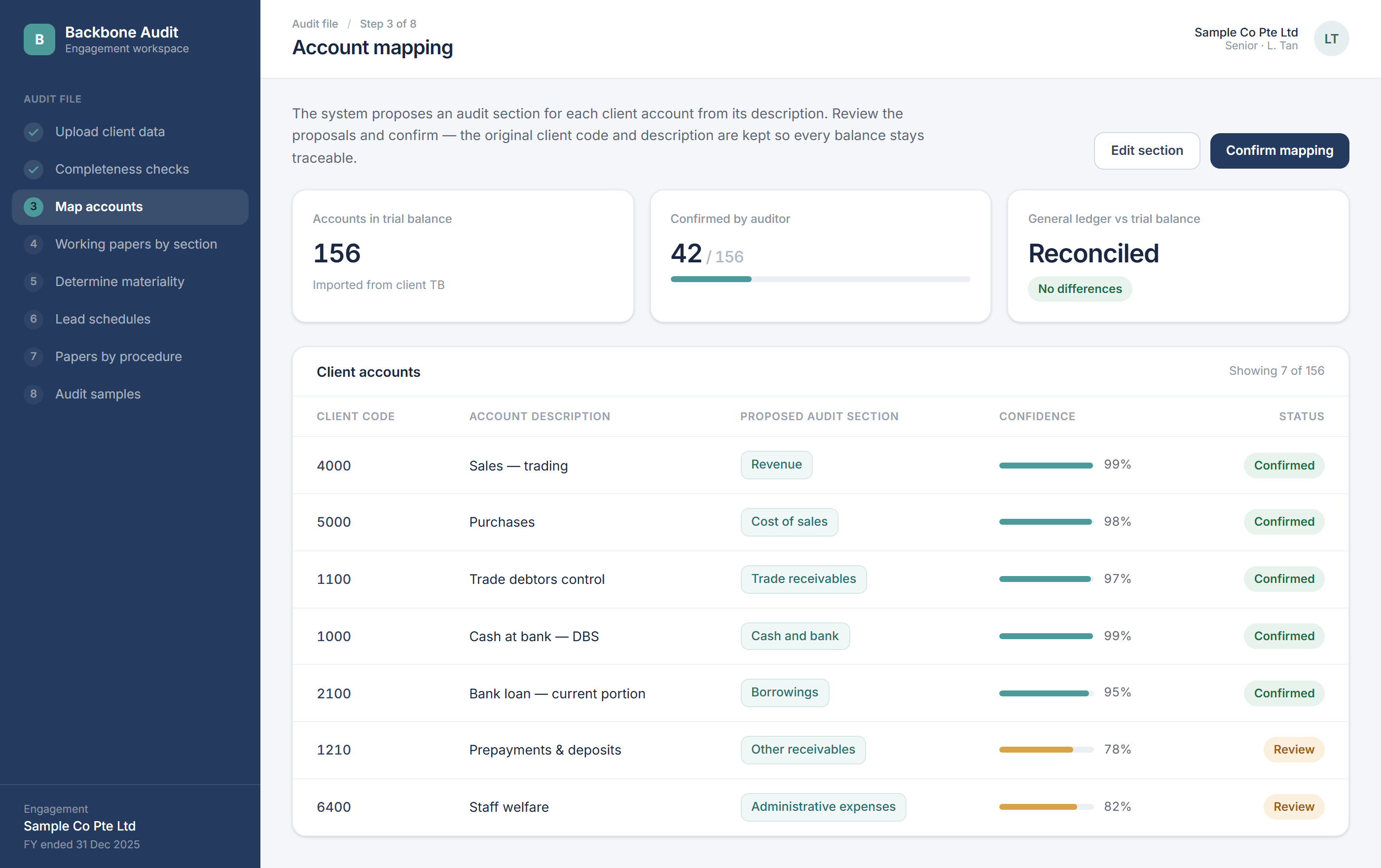
The approved mapping becomes the common link between the trial balance, financial statement sections, lead schedules and detailed working papers. The system retains the client's original labels so reviewers can trace a presented balance without reconstructing how it was grouped.
A revised trial balance should not overwrite the approved mapping without review. New accounts, changed descriptions and altered balances should appear as changes for the engagement team to resolve.
How are lead schedules and working papers prepared?
The workflow populates each lead schedule from the approved mapping. It brings together current-year and prior-year balances, account breakdowns and movements without requiring the team to re-key the same figures.
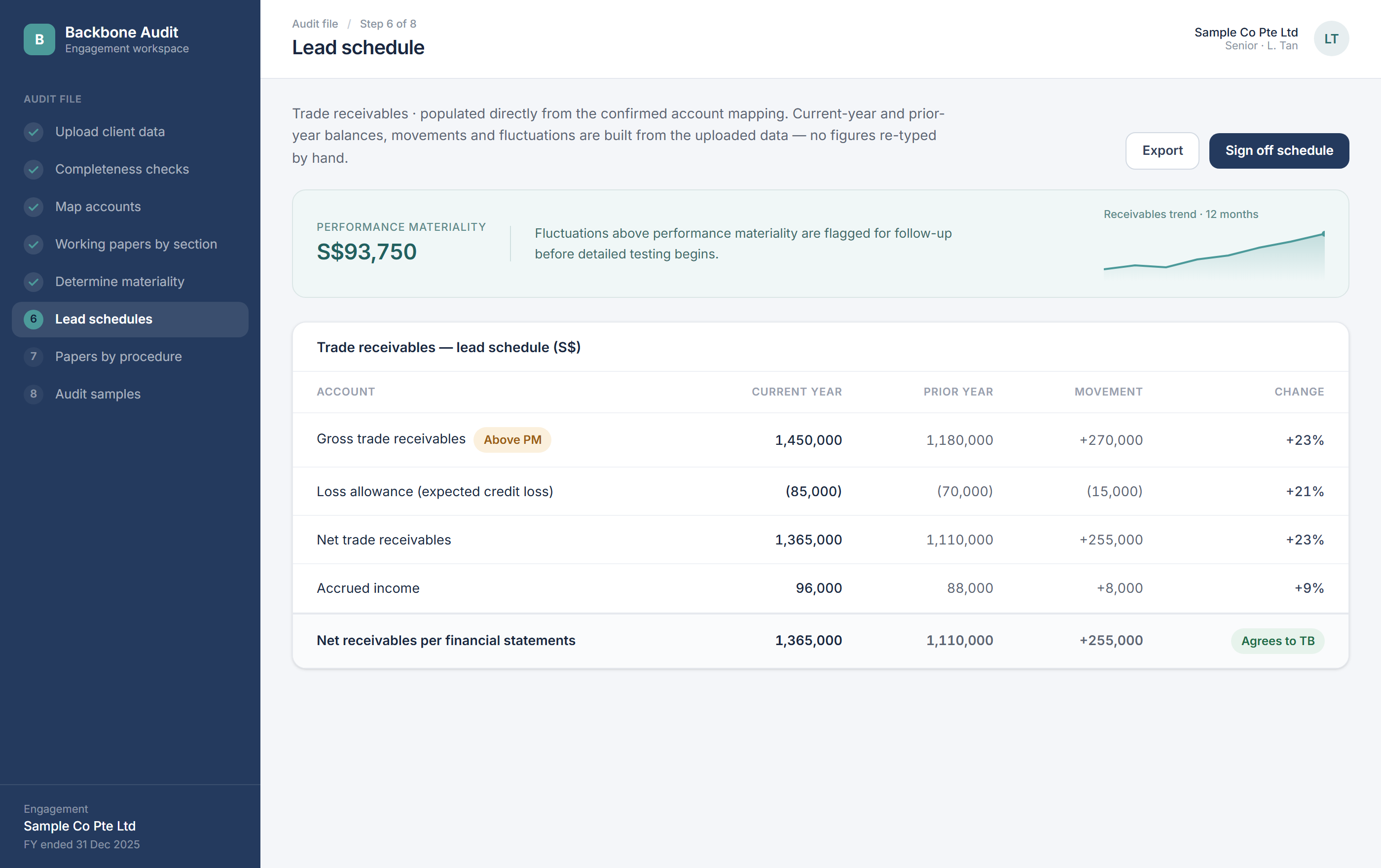
It then prepares working papers for the procedures selected under the firm's methodology. Each paper receives the relevant population, source references, configured calculations and fields for evidence, exceptions and conclusions.
| Audit file component | What the workflow prepares | What the auditor controls |
|---|---|---|
| Client data | Structures the uploaded files | Resolves completeness exceptions |
| Account mapping | Proposes the audit section | Approves or corrects each mapping |
| Materiality | Calculates from approved inputs | Selects and approves the inputs |
| Lead schedules | Populates balances and movements | Reviews fluctuations and follow-up |
| Working papers | Loads the structure and population | Selects and performs procedures |
| Sampling | Applies the selected method | Defines the population and approach |
| Conclusions | Lists exceptions and open matters | Evaluates evidence and concludes |
This structure supports the documentation responsibilities addressed by Singapore Standard on Auditing 230. It does not treat a populated template as evidence that the procedure was completed.
How does sample selection remain traceable?
For a procedure requiring sampling, the auditor confirms the population and selects the method required by the firm's methodology. The workflow applies those instructions and records the population, sample size, method, parameters and selected transactions.
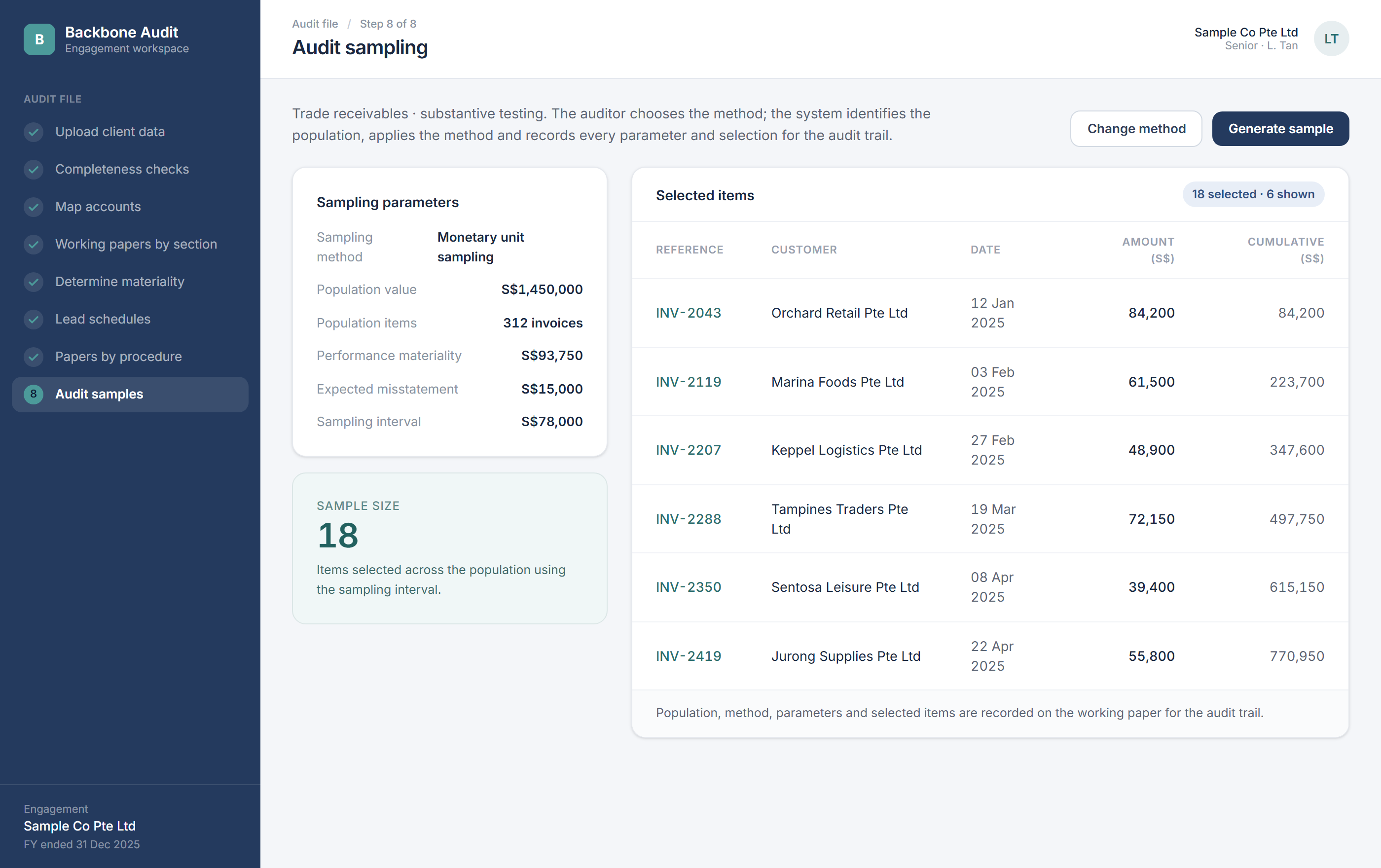
The sample list remains linked to the imported ledger rather than becoming an isolated spreadsheet. A reviewer can therefore inspect how the population was formed and reproduce the selection from the recorded parameters.
The Institute of Singapore Chartered Accountants lists audit documentation, materiality and audit sampling within its current Singapore Standards on Auditing. The firm still determines how those requirements apply to the engagement.
What keeps the workflow controlled?
Every judgement point needs an identified owner and recorded approval. The system should not confirm data completeness, accept a proposed mapping or determine that audit evidence is sufficient.
Version history matters because client data and audit plans can change during the engagement. The workflow should record who uploaded each file, what changed, which schedules were refreshed and which papers require another review.
Exceptions can then flow into the process for turning audit findings into management letter points. The same controlled hand-off also follows the division between system preparation and human approval used by an AI agent working across business processes.
Backbone helps audit teams connect client data, mapping, lead schedules, working papers and sampling in one controlled workflow — while keeping professional judgement and approval with the auditor.
Frequently asked questions
This information has been prepared for general informational purposes only and is not intended to be relied upon as accounting, tax, or other professional advice.
Related articles
case-studies
From Audit Findings to Management Letter Points
How audit teams can connect findings, evidence, prior-year points, review and management responses in one controlled management letter drafting workflow.
articles
Rethinking Audit Exemptions in Malaysia
A conceptual take on Malaysia's proposal to raise the audit exemption threshold, why easing statutory audit for small companies can benefit businesses and the profession, and why the threshold measure itself deserves a rethink.
articles
Dynamic Array Formulas in Excel: Unleashing the Power
How Excel dynamic array formulas such as FILTER and XLOOKUP spill results across cells, so accountants can build scalable, error-resistant templates and audit working papers.