From Headcount Plan to Payroll Forecast
How finance and people teams can maintain an employee-level payroll forecast as hiring, compensation and employer-cost assumptions change.

Xian Hui
11 August 2026
Quick answer
How can headcount and payroll forecasting be automated?
A connected payroll forecast applies employee-level assumptions for salaries, planned hires, reviews, promotions, bonuses and employer costs. It recalculates monthly expense and cash flow when those assumptions change, replaces completed periods with actual results and flags deviations for investigation without requiring finance to rebuild the forecast each month.
From Headcount Plan to Payroll Forecast
Payroll is one of the largest operating expenses for many organisations. It is also highly predictable when the forecast reflects the people, contractual terms and employer costs that create it.
That predictability makes variance useful. When actual payroll departs from a well-supported forecast, the difference may signal an unplanned hire, delayed resignation, incorrect payment or another risk requiring investigation.
The difficulty lies in maintaining the assumptions. Joining dates, promotions, salary reviews, bonuses and employer costs change frequently, particularly in larger organisations with varied roles, locations and staff demographics. Finance must roll the forecast forward every month without losing those changes.
Why does payroll need an employee-level forecast?
Average headcount multiplied by average salary can support a broad budget, but it cannot explain payroll precisely. Each employee or planned position contributes a different amount from a different date.
A useful headcount forecast therefore holds:
- employment status and effective dates
- entity, department and cost centre
- base salary and allowances
- review or promotion dates
- bonus and employer-cost assumptions
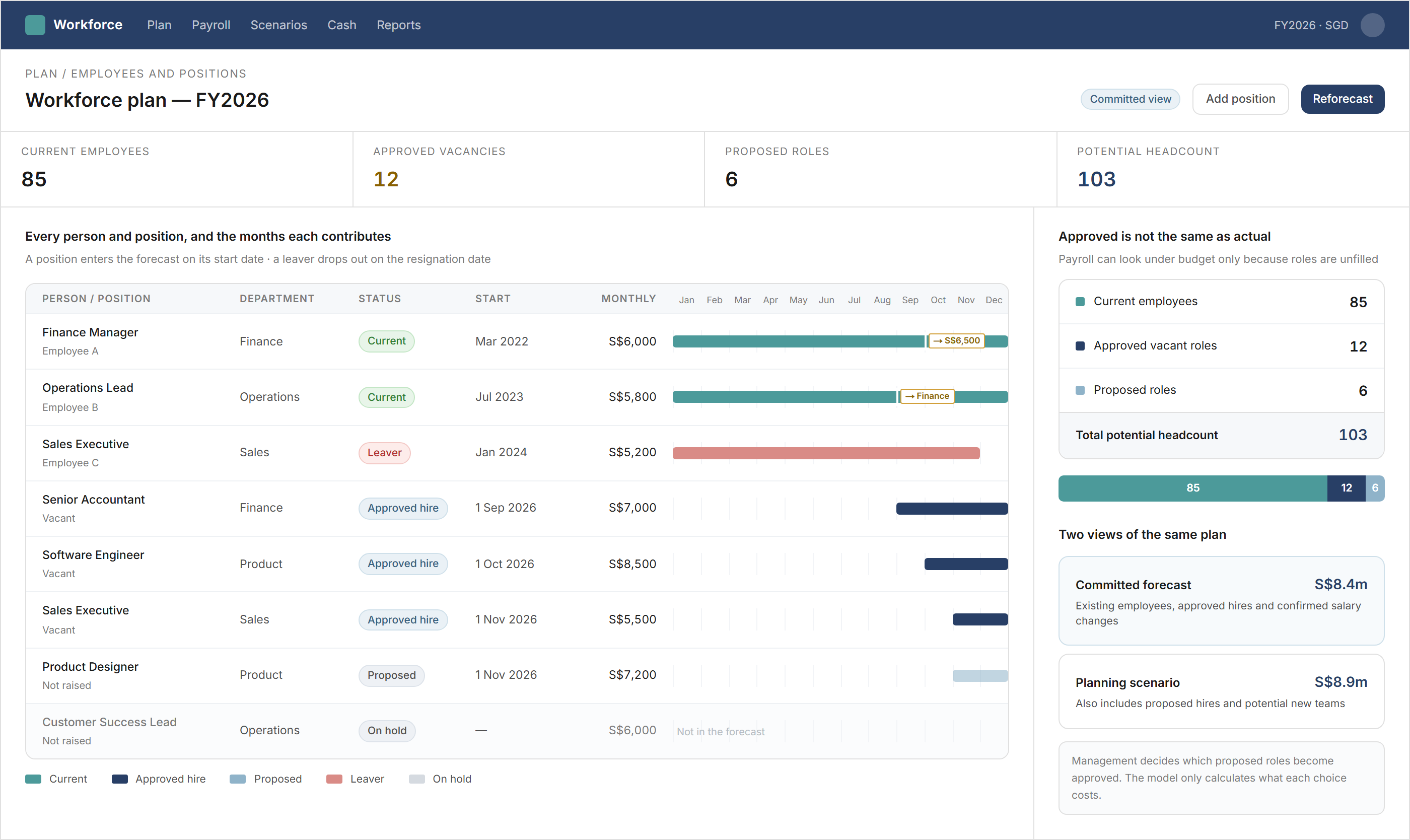
Planned positions also need an expected salary, start date and approval status. Separating current employees, approved vacancies and proposed roles prevents an unfilled position from appearing as a permanent saving.
For example, a Senior Accountant with a monthly salary of S$7,000 and a September start date contributes four months of salary to the current-year forecast. Moving the start to November should remove two months from payroll expense, cash flow and departmental cost through one change.
Why is payroll software not the forecasting tool?
Payroll software calculates what the organisation should pay its current employees for the present cycle. It applies current employee records and pay components, then produces payments and payroll reports.
That purpose is not forward-looking. The system may not represent approved vacancies, proposed hires, future promotions or alternative joining dates before those events enter the employee master file. Recruitment fees, insurance, benefits and other employee costs may also sit outside payroll.
Payroll data remains a sound starting point because it describes the current workforce. It should feed the forecast rather than determine what the organisation can project.
Why do FP&A and analytics platforms fall short?
Financial planning and analysis platforms can consolidate departmental plans and compare scenarios. They often capture workforce assumptions at too high a level, such as headcount multiplied by average salary and one general increment percentage.
An average increment cannot express a promotion for one employee, an individual salary review for another or a contract change from a specific date. The model needs that detail per employee before aggregating it for the wider planning environment.
Individual compensation also requires restricted access. A broadly shared analytics platform may be suitable for departmental totals but unsuitable for names and salaries. Finance and authorised people-team staff can maintain the detailed model, then send summarised results into the wider plan.
| Tool | Useful input or output | Forecasting limitation |
|---|---|---|
| Payroll software | Current employee and completed payroll data | Does not usually model planned hires and alternatives |
| FP&A platform | Consolidated plans and scenarios | May use assumptions that are too general |
| Shared analytics platform | Departmental reporting | May expose sensitive compensation data |
| Employee-level model | Dated assumptions and monthly calculations | Still requires controlled inputs and approvals |
How does the connected model calculate payroll?
The model starts with current employee records, then adds approved changes and planned positions. It calculates active months, compensation, employer costs and cash timing for each record before aggregating the results.
The monthly process is mechanical:
- Import current employee and payroll data.
- Record future changes with their effective dates.
- Add planned positions and approval status.
- Calculate expense and payment timing.
- Aggregate by entity, department and cost centre.
Changing one planned start date updates headcount, salary, employer contributions and cash flow from the same assumption. The model can also separate committed positions from proposed roles so management can compare plans without confusing them with approved recruitment.
How are employer costs and payment timing handled?
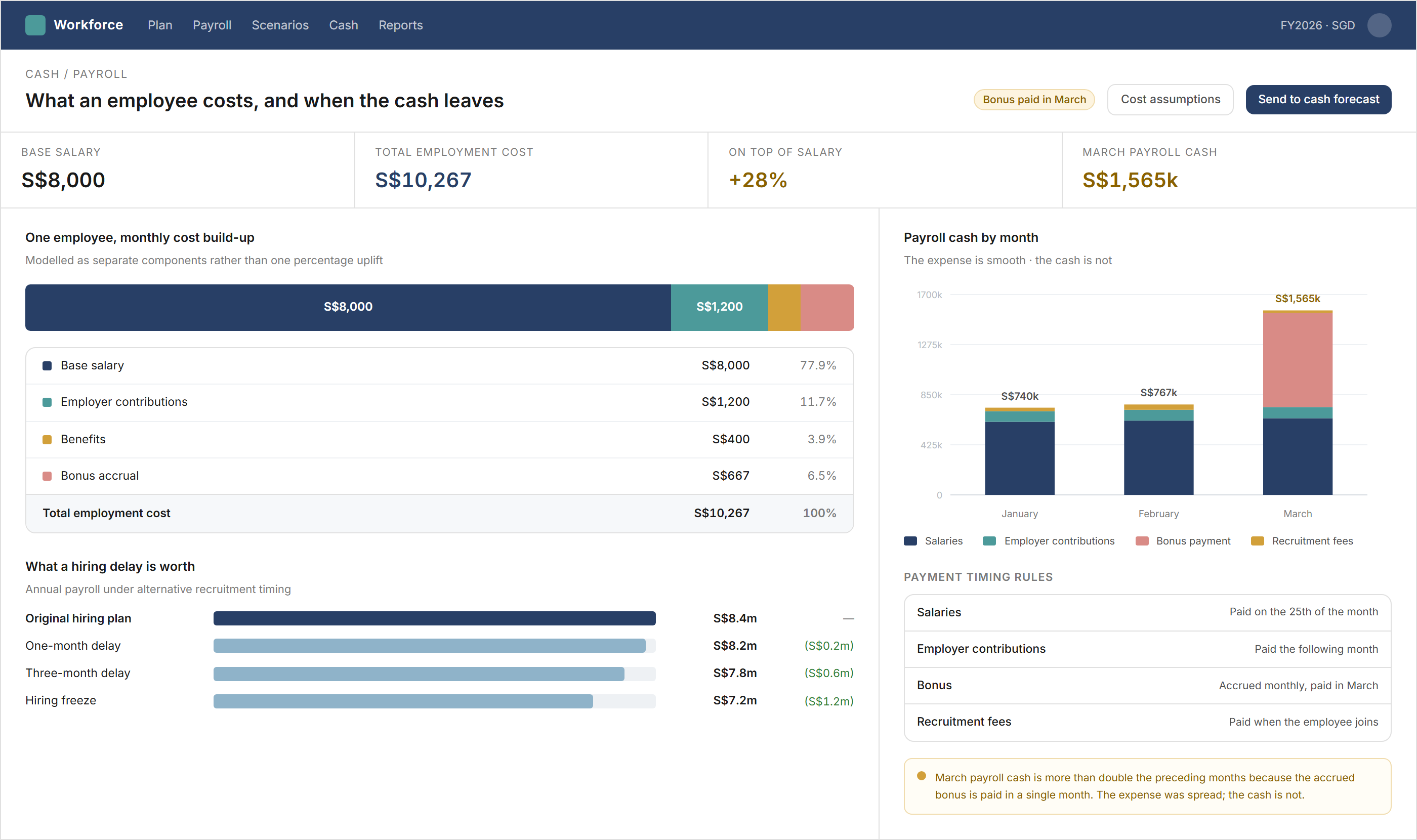
Gross salary does not represent the full employment cost. The model should calculate relevant contributions, benefits and variable pay separately because they may follow different rules and payment dates.
For Singapore employees, the Central Provident Fund Board publishes employer CPF contribution requirements. The Ministry of Manpower publishes annual-leave requirements. Finance applies the relevant requirements and the organisation’s approved policies to each employee.
Expense and payment timing may differ. Salaries can be paid during the month, employer contributions later and bonuses after the period in which they accrue. The payroll model should pass those payment assumptions into the rolling cash flow forecast.
How does the forecast become a monthly risk control?
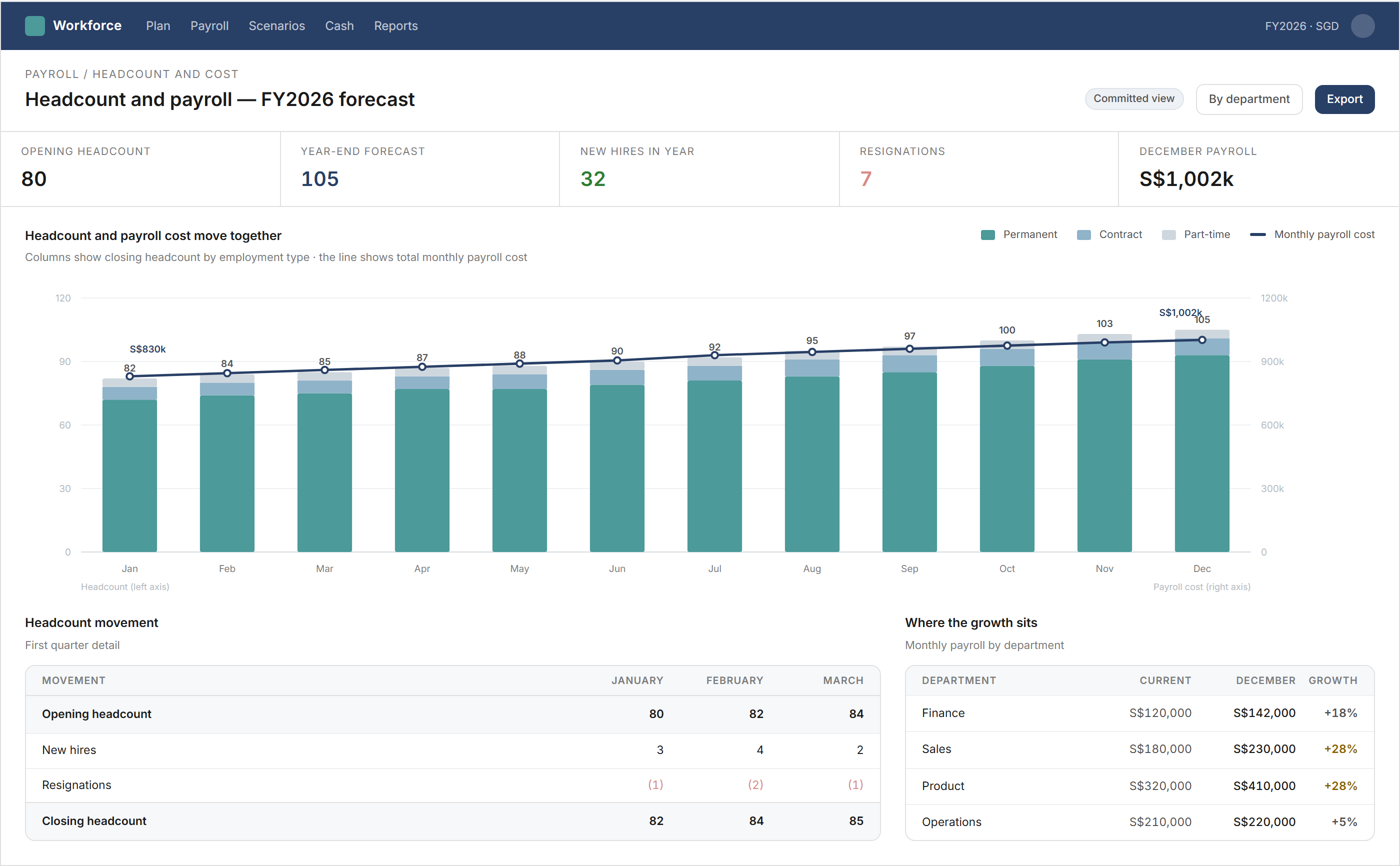
After each payroll cycle, finance imports actual results and compares them with the employee-level forecast. A small net difference can conceal offsetting movements, so the review must identify the drivers.
The rolling process replaces the completed month with actual payroll, reconciles employee and position movements, updates approved assumptions and adds a new forecast month. This retains a consistent horizon without rebuilding separate schedules.
A confident forecast changes the meaning of a deviation. Finance can distinguish a timing difference from a one-off payment, an unrecorded workforce decision or an error requiring correction. Confirmed payroll and related journals can then feed the month-end closing workflow.
Where does human control remain?
The model calculates the effect of workforce decisions; it does not make them. The people team confirms employee records, management approves roles and compensation, and finance approves the calculation basis and investigates variances.
Access should follow those responsibilities. Managers may receive departmental totals without individual salaries, while authorised finance and people-team staff maintain the underlying records.
Backbone helps finance and people teams connect workforce plans, compensation assumptions, employer costs and actual payroll in one rolling forecast — while keeping hiring, compensation and accounting judgement with management and finance.
Frequently asked questions
This information has been prepared for general informational purposes only and is not intended to be relied upon as accounting, tax, or other professional advice.
Related articles
case-studies
From Historical Cash Movements to a Rolling Cash Flow Forecast
How finance teams connect bank balances, receivables, payables and planned commitments to maintain a rolling cash flow forecast.
case-studies
Pat: An AI Agent That Works Across Our Business
How an internal AI agent retrieves information, prepares routine work and coordinates approved actions across business systems while people retain authority.
case-studies
From Subsidiary Trial Balances to Consolidation Packages
How group finance can standardise subsidiary trial balances, reporting schedules, intercompany balances and adjustments before consolidation begins.